Montag, 27. April 2015

Quilt Book, Vol.2: Appliqué


So this is my second quilt book, it's a sampler again, this time showing some examples of appliqué techniques with different cultural and historical backgrounds. 
My first quilt book was a small collection of some patchwork examples from different areas and eras.

The general idea behind these books is basically to "talk about" and thereby to celebrate and to bring together different traditions, coming from very different sources, and to create a feeling of belonging to them all, as we somehow are a part of them, regardless of the time or the place where we find ourselves right now.
Like all quilts do, these books ultimately talk about


 The first page shows a flower appliqué, done with hidden stitches, which is reminiscent of the lovely motifs of the "Baltimore Album" quilts, popular in North-America during the 1840s/1850s. 


The second page shows a Folk Art motif. 
"Folk Art Quilts - 
As Americans moved westward, women used the medium of the quilt to make pictures of the world around them or the world they left behind." 
(The Quilt Encyclopedia Illustrated, by Carter Houck, Museum of American Folk Art, 1991)
Here I used hidden stitches as well as the blanket stitch and added some embroidery. 
I found the pattern here: 
Better Homes and Gardens: 501 Quilt Blocks


This fish on the third page is done with the multiple reverse appliqué technique used by the Indians of Panama; such a piece of work is called "Mola" and shows some additional embroidery also.


On the fourth page I tried to capture the lovely geometrical symmetries the Vietnamese Hmong people use in their typical way to make reverse appliqués in bright colors, and, as you can see, I hadn't been able to be perfectly exact here.  (I made peace with the fact that I never am able to work perfectly exact, and very often I don't even try it. I think there is some charm in the unevenness of things, but here… some more symmetry would have been just fine.) 


Ahh, I so much love how the Hawaiians do their quilts, this is just a modest attempt to go in that direction. A top layer is cut into one symmetrical form and then sewn onto the background fabric by way of needle turn appliqué. Then the quilting stitches go in waves around the appliquéd form.


And the back cover of my book is a combination of patchwork and appliqué:
the flower is pieced together first, after a traditional clamshell pattern, and it's complete in itself, batting, backing and quilting stitches included. Then this flower-form is appliquéd with hidden stitches and some quilting is added. 


In both books the pages are batted with quite a thick cotton fleece, so that the books can stand upright on a shelf: 


If you are interested, here is more information

- on my first book about patchwork techniques, showing also five examples:

It is also mentioned in the magazine "Patchwork Professional" (German), 02/2015, on pages 52 and 53.

- on Baltimore Album quilts:

 - on Folk Art Quilts: 

- something I've written earlier here about Molas: 

- on Hmong applique: 

- something I've written earlier about Hawaiian appliqué:


Donnerstag, 23. April 2015

Happy World Book Day!


"Books are the quietest and most constant of friends; they are the most accessible and wisest of counselors, and the most patient of teachers."
Charles William Eliot

http://www.goodreads.com/quotes/tag/reading


These pictures were taken at the Book Village Bredevoort, Netherlands, 
what a lovely place that is! I had been there on a cool day, so I am all bundled up at the very nice "English Bookshop", where I bought a great antiquarian book: "The Ultimate Cross Stitch Companion"! :-)


And this is one of the bookends I made.

Happy Reading!


Donnerstag, 9. April 2015

2014-Quilt Completed


I just finished the quilting and binding of my quilt "2014",
which shows one self-designed block for each month of the last year.
So it now got a "face".

The dimensions are 96 x 124 cm (about 38" x 49"),
it's all sewn and quilted by hand, and I used cotton yarn and fabrics.
The batting is a smooth and somewhat thick cotton sheet.

I debated the point with myself whether to hang it with a second rod in a long sleeve at the bottom end of the quilt, 
so that it could hang more evenly and smoothly,
but then again it wasn't such a plain and smooth year,
so no, 
and yes, I added a second rod at the bottom, but it hangs in small loops;
 that way I can add some straightening with a second rod below for better hanging, 
but I can also allow of some slight "wave" and movement 
for the form on the whole.


Mittwoch, 1. April 2015

Sunburst


This is the first block of a new big quilt I plan to make.
The name of the pattern in the center of this block is "Sunburst" 
and I love everything about it:
the name, the way the pieces are arranged, the harmony in it,
the combination of different fabrics, which make each other glow.
It's an old, traditional pattern and appears in various variations in quilts from the last century and earlier, 
I have seen it in quilts even from the time around 1850…
I think it's just the right pattern for celebrating the arrival of spring!

"Behold, my friends, the spring is come; the earth has gladly received the embraces of the sun, and we shall soon see the results of their love!"

Sitting Bull

http://www.brainyquote.com/quotes/keywords/spring.html


Freitag, 20. März 2015

Sonntag, 8. März 2015

Bookmark for Kids


ah well, since I worked on some bookmark designs over the last weeks, I really wished to make something for kids also, and here they are: some cows to accompany a child while experiencing the adventure of reading a book…

"I touched one for the first time. I'd seen the older children in class look into books for invisible traces, as if they were driven by the same force and, sinking deeper into silence, they were able to draw from dead paper something that seemed alive.
Unbeknownst to all, I learned to read."

… from the wonderful book "The Elegance of the Hedgehog" 
by Muriel Barbery


The book shown here is the German version of "Winnie-the-Pooh", "Pu der Bär", by A.A.Milne, Illustrations by E.H. Shepard, first published in 1926

Freitag, 20. Februar 2015

"Secret-Garden"-Bookmark


"Is the spring coming?" he said. "What is it like?"…
"It is the sun shining on the rain and the rain falling on the sunshine…"

Frances Hodgson Burnett, The Secret Garden 


http://www.goodreads.com/quotes/tag/spring

"The Secret Garden"!
One of my favorite books ever.
Here is my well-read copy, and this bookmark:


Mittwoch, 11. Februar 2015

Between Winter and Spring


We cannot stop the winter or the summer from coming. We cannot stop the spring or the fall or make them other than they are. They are gifts from the universe that we cannot refuse. But we can choose what we will contribute to life when each arrives.

Gary Zukav 

http://www.brainyquote.com/quotes/keywords/spring.html

Ahh, Gary Zukav! I've read all his books and love them all.


When these snowdrops appear I know spring is not too far away anymore: 


I made a couple of bookmarks with white petals to celebrate this change of the seasons: 


The book shown here is one I like very much:
American Impressionism, by Richard J.Boyle.
The pages show parts of the paintings 
"The Mill in Flood, Giverny" (1910) by Theodore Butler  (to the left) and 
"Old Holley House at Cos Cob" (circa 1890-1900) by John Twachtman (to the right)


Freitag, 6. Februar 2015

Mola Bookmark


With this bookmark I've been trying out the special Mola appliqué technique.
The Indian women of the Cuna-Cuna or San Blas Islands tribe of the north coast of Panama are famous for their use of a reverse appliqué technique with layers of different colors, each color being revealed as a bright outline when the layer above is cut away.
Original Molas often show pictorial or geometrical designs which mirror myths or everyday experiences.
There is no way to reach the expertise and mastership of these Indian women, what I am exploring here is just an attempt to learn more about cultural influences which enrich the work and the life of us all, 
and I am so grateful for that!

I worked with three layers of fabric (typically two to seven layers are used), and here I have cut the first layer away and I hand-stitch the first round of appliqué. Since I have clipped the edges carefully this process of turning under the edges and sewing them down along the curves is not so difficult to perform, although I am being far from perfect at this. It helps to use a thread in the same color as the fabric that is being sewn, and it looks best if one uses very small hidden stitches.


In addition to that it's popular to cut open some small upper parts and to put under and fix new pieces of fabrics in new colors. Also some additional surface appliqué and embroidery (often in the shape of triangles, circles and small rounded off rods) are typically used to complete a motif. 


In order to make a bookmark with my layers of fabrics 
I added a white border to frame the motif, 
I used a piece of sackcloth for the batting,
 as well as a piece of yellow fabric for the backing. 
Some embroidery stitches also served as quilting stitches to help to keep all layers from shifting.

The book shown here is a wonderful one:

"Native American Modernism", by Peter Bolz and Viola König,
Staatliche Museen zu Berlin, Michael Imhof Verlag, 2012

The extraordinary painting is:
Peyote Princess, ca. 1975, by Beatien Yazz (Jimmy Toddy), Navajo,
Ethnology Museum Berlin


(click to enlarge a picture)

Sonntag, 25. Januar 2015

Quilt Book


I love books, and I love quilts. 
And I think that every quilt tells a particular story 
about the maker and the owner and the time when it was created, 
with the pattern that was chosen, with each stitch, 
with each piece of fabric… 
So I think it's only natural to show some story-telling quilts in a book!


So here is a compilation of short stories (it's not a novel or a coherent narrative of any longer kind, maybe that's something for later, I could do a garden-book with seasonal floral patterns some time for example, or with several blocks showing antique toys, playing together...so many possibilities...I like that idea!) -

but the five quilt-pages and the two cover-quilts connected here are each telling something about the cultural backgrounds they come from (Amish, African American, Modern European, Japanese, Anglo-American), they suggest and reveal something with their titles (Interwoven, Amish Diamond, Round Robin, Bars, Log Cabin Variation… the titles are written on the back of each quilt-page) and with their colors and the way they feel when the book is held in hands. 
And most of all, they share the message of something warm, handmade, joyful.


The pages each show a square of 21cm (8,2"), the batting is strong cotton fleece to give some consistency to the book. This way it can stand freely on a shelf. Added to the squares is a button border with three button holes. Six buttons, pairwise connected with an elastic cord, hold the pages together and form the spine of the book.


On the front cover I put a small (reverse) Hay(na)ku-poem:

Step by step
It's all
Patchwork


The back cover is a Zokin, done Japanese style.
I found out about Zokins (roughly woven cotton-and linen-pieces which are sewn together and quilted Sashiko-style) while reading a nice article in the magazine "Patchwork Professional"01/2015, I do like that magazine a great deal, it provides a wonderful variety of information and  inspiration.


Freitag, 16. Januar 2015

Katagami - Logical Rain


They were found in these boxes.
In Dresden, in September 2013, Wolfgang Scheppe found these 92 boxes while exploring the depots of the "Staatliche Kunstsammlung Dresden" (Germany).
These boxes held the world largest collection of 16000 Japanese hand-cutted paper stencils, used for dyeing textiles, mainly Samurai kimonos, a craft that doesn't exist any more in its original form. The time when this craft had been practiced in its traditional and pure way is mainly dated the period of the Edo-era in Japan (1603 to 1868).

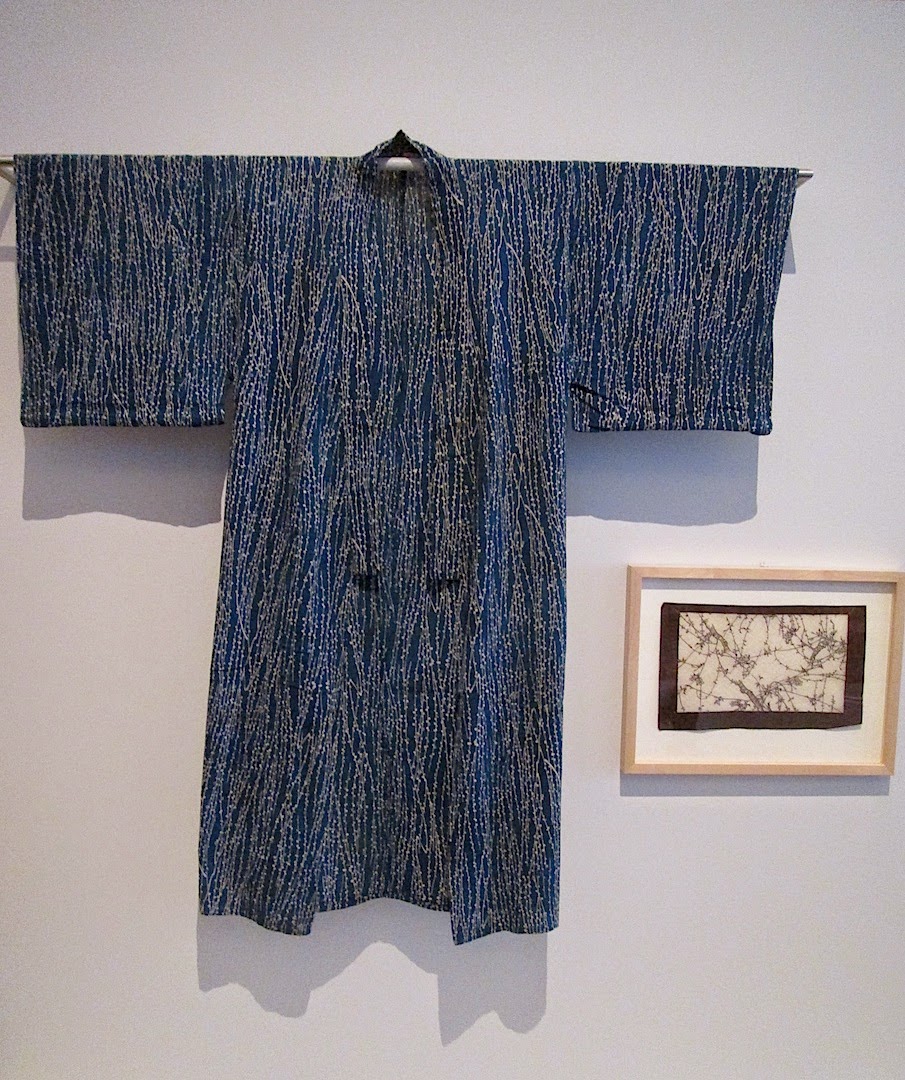
I had been to the Katagami exhibition "Die Logik des Regens - Logical Rain" in Dresden at the Japanese Palais. They showed 140 stencils which meditate on the motif of "rain". I was allowed to take some pictures, which turn out to be interesting because they appear in different lights. The light in the showroom changed to signify different shades of light during a rain, and the visitor is accompanied by different sounds of rain also. Very nice.
I can only show some of my pictures here, but if anyone is interested, I can send more photographs via e-mail (MARIASmail@t-online.de)


The Katagami - craft is mainly characterized by its enormous amount of invested time, patience and precision. The pieces consist of mulberry paper that needed up to eight years to gain the right quality and consistency. With specifically manufactured instruments and after traditional recipes the papers were glued together to form a thin pile of layers (about six to twelve). 
Into these layers were ever so slowly and carefully cut the most intricate patterns, with knives that were sharpened daily for long hours.


Patterns were poetic and ornamental ones for kimonos for women, and more abstract and geometrical ones for kimonos for men, but always designed with enormous delicacy. So there were patterns which showed up to 23 lines within the width of three centimeters (1,3") of paper, or 900 holes on three square centimeters. It is said that a master could only perform his intricate work for about 30 minutes, he then had to change to some other task in order to not lose his ability to concentrate. One mistake would have damaged an object of immeasurable value.
The stencils are then one by one put onto the fabric while forming an exact rapport, and a certain mash is given onto the fabric through the holes and cuts. At these places which are protected by the mash no color can sink in. After removing the stencils the color is given onto the free lines and spaces of the fabric with special brushes. After that the fabric is treated with steam to make it colorfast. At last the mash is washed out.
Usually the pattern is finally to be seen as white or natural colored lines on cloth that had been dyed indigo blue before. 
The whole process of manufacturing the paper, the instruments, of creating the patterns and finding the right recipes for the glue, the mash and the colors lay in the hand of one master. His knowledge often was held as a secret and only passed on within the family.


Sometimes - for example for multiple and multicolored prints - the fragile paper stencils had to be stabilized and put together again. This was done with silk threads that were sewn onto the papers and which formed a stabilizing net. Often this work was done by the wife of the Katagami master. The last two women who were able to master that special Itoire-craft died during the seventies of the last century.


I find it especially interesting, that some of these ancient paper stencils occasionally show patterns which resemble traditional quilt patterns (for example Clamshell or Applecore). There seems to be an ancient source for all these forms which appear in all human cultures and connect them.


( I found this lovely picture of an Applecore-quilt here:
http://gumvalleypatchwork.typepad.com/my_weblog/2012/08/applecore-quilt-class.html


(detail of a table mat I did, spool pattern)


The exhibition in Dresden offers an excellent brochure on the subject of Katagami, I found much of the information given here in the exquisite essay by Wolfgang Scheppe there, and also in the article in the "Süddeutschen Zeitung" by Ira Mazzoni.