Dienstag, 15. März 2011

Pockets of Happiness


"The thought has cheered me, and I'd like to hang on to that. Must protect my little pockets of happiness." says the old man in the lovely book "Water for Elephants" by Sara Gruen, thank you so much, Fran, for recommending it to me! I love it.


Pockets of happiness are now more important than ever.
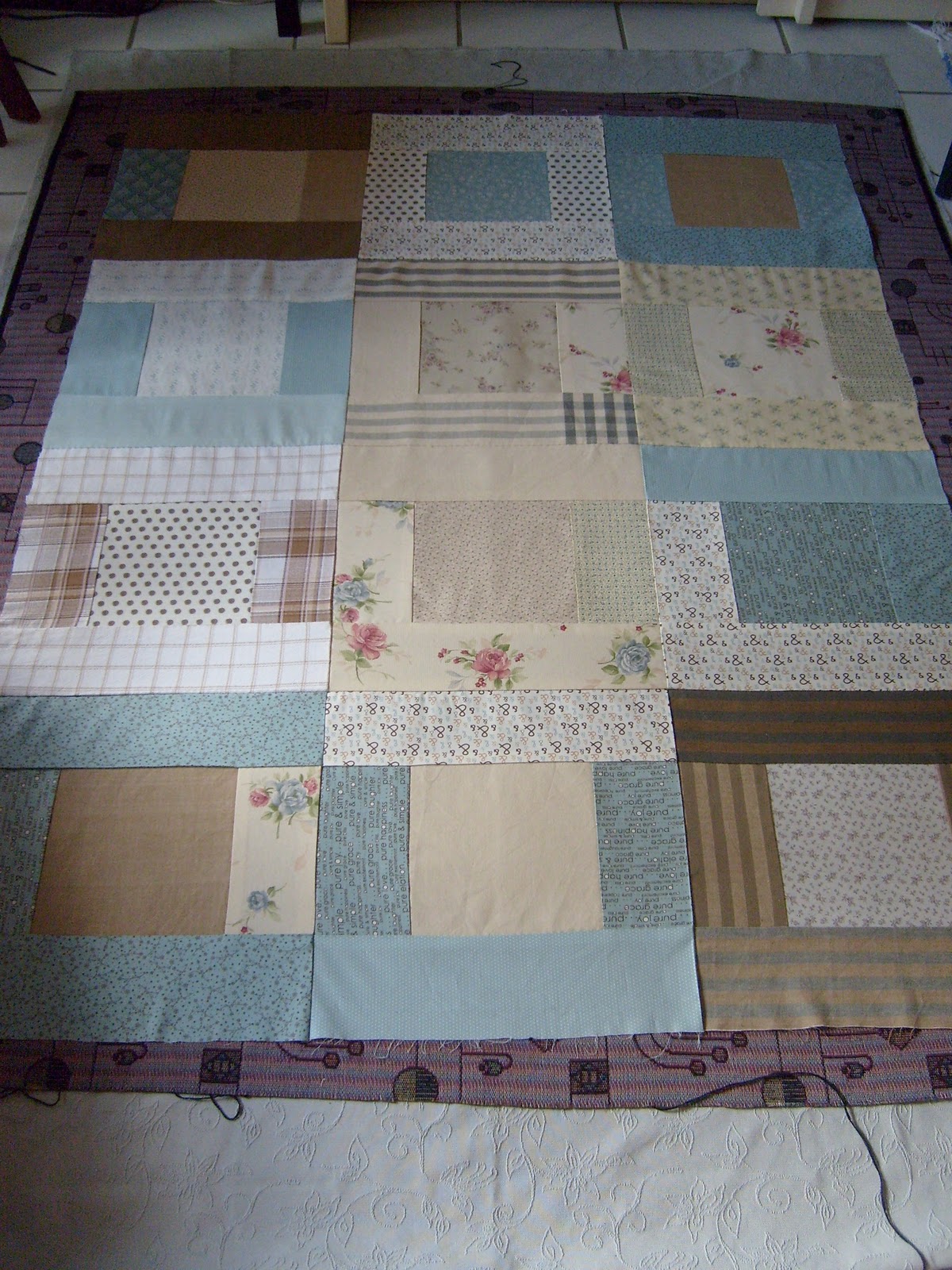
Now, here is my second quilting project I'm working on at the moment : one of my  pockets of happiness .


It's a piece that grows only very slowly, but in a lovely way: the pieces are about the size of a stamp (or half the size of a stamp sometimes). I don't have any plans with it, I just add one piece after the other as it comes and we'll see when it will be finished. Also, it's a great way to use remnants. I'm sparing with my fabrics, so: what's even too small to be used here is going to a stack of tiny remnants with which I fill my stuffed animals and dolls.


Here is another "pocket of happiness": flowers. I took a picture of a blooming hyacinth and my camera (a simple one) refused to take a sharp picture, but I like it anyway, the picture looks a bit like a painting... :-)


And then, my breakfast is a "pocket of happiness", I love my daily oatmeal and fresh fruit!! Delicious! With a darjeeling tea, a bit milk.... hmmmm! (This picture was taken in Madison, Wisconsin, last summer.)


Montag, 14. März 2011

I Started Out On A New Quilt


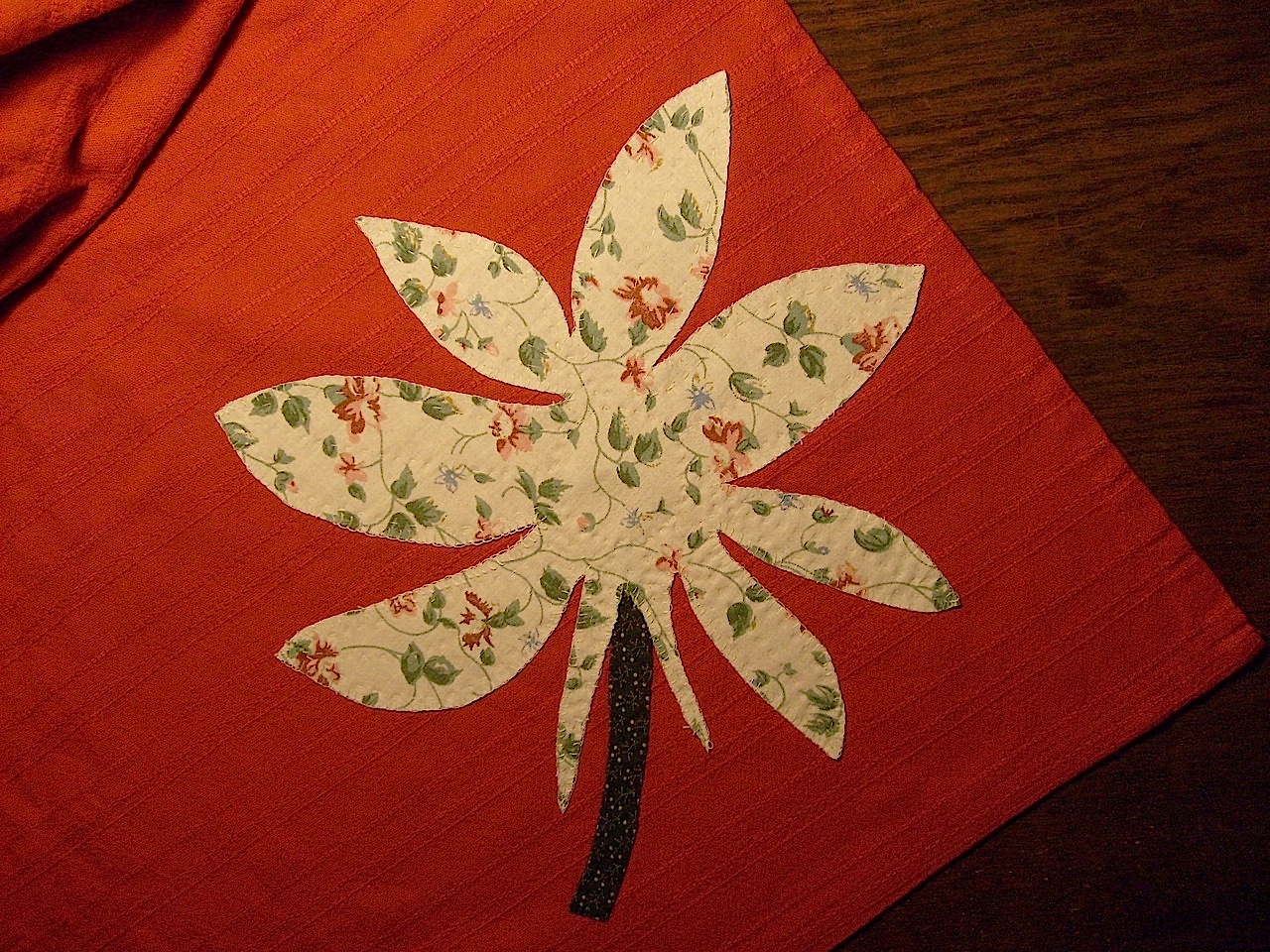
Despite all the sadness in the world, I began to work on a new quilt.

I will cover a huge red cloth with lots and lots of appliquéd leaves and flowers.


Samstag, 12. März 2011

A Candle

Our lives are like a candle in the wind.
- Carl Sandburg


Donnerstag, 10. März 2011

How I Once Planned A Quilt


I finished a new quilt today.


This is the way it went: 

 I started out to make a light summer quilt with only light fabrics and a beautiful pattern of diamonds (diamond = a square which is set on top, this often stands for "protection" in African American quilts). I planned to have them all neatly arranged one next to the other. Nice bright border around. I made all the calculations for dimensions. It seemed to be plain and easy to do.
The part with which I started is now the middle part of my quilt.
To the bright fabrics I swiftly added some dark red and brown fabrics. It looked too cool to me without them (even in a summer quilt). Checked cloth looks cozy to me, so I found myself using it often here, too. 
Then I felt like abandoning the original pattern altogether and I moved on freely with some pieces arranging here, some pieces arranging there, all around the first three diamonds. Then I felt like giving all this a firm, strong border in warm dark red (to hold it all together a bit).  But once this border was attached I began to improvise with pieces again (which is not that easy to do). 
I used lovely antique, embroidered cloth as well. I have inherited a stack of that.
Then I was thinking about complementary colors, and - to answer the red part -  I added some green (after having put green in and out before). Green, however, reminds me of a friend who plays an important "complementary" role in my life, so I am glad: the green is worked in. Twice, a bigger and a smaller piece. 


Then I added a tiny piece of bright fabric with a floral design, reminding me of a friend who worked on her fabulous quilt  sometimes directly next to me; she used this fabric in her quilt. 


Then my sisters returned from a trip to France, and presented me on my birthday with linen from a market in the Provence, and I added it promptly here.
Then I attached a checked border all around, with some fabric I had purchased only recently for a quite different purpose (Christmas bags for the family), but I saw it fit right here now.
I planned to quilt the whole piece with regular diagonal lines at first, but then I quilted squares, diamonds, zigzag and meander lines, and not only with bright yarn, as I originally had intended: I found lovely red yarn at a department store in Berlin, so I used that, too. (not in the picture)


Finally,  I added another border (but only at three sides). I luckily received a checked cotton remnant in red and beige on my sister's birthday party (together with a huge sack of other remnants, from a nice lady who runs a Bed & Breakfast, just because we talked about quilts...) , now it makes a lovely part of my outer border here.
I started to make this quilt in August 2010 and since then I had laid it down to rest for some time in between very often.
In the end now I'm happy with the result!  I never would have been able to plan something like that!!
It is still a quilt for the summer, it is thin and weighs next to nothing, so I achieved my initial goal, but that is all that remained of my original ideas.


How Things Come Into Being


These lines here are from the wonderful book "Eat Pray Love" by Elizabeth Gilbert:


"They say that an oak tree is brought into creation by two forces at the same time. Obviously, there is the acorn from which it all begins, the seed which holds all the promise and potential, which grows into a tree. Everybody can see that. But only a few can recognize that there is another force operating here as well - the future tree itself, which wants so badly to exist that it pulls the acorn into being, drawing the seedling forth with longing out of the void, guiding the evolution from nothingness to maturity. In this respect, say the Zens, it is the oak tree that creates the very acorn from which it was born."


Dienstag, 8. März 2011

How I make a Quilt


A friend asked me today whether I have a plan in mind when I work on a quilt and then go step by step. This is so interesting!!! Because I often have plans and then I end up using them only as a frame and I watch myself adding new elements ... There is no way I can follow an original plan piece by piece  if I don't feel like it. Even if I wanted to, I just can't.
However, after thinking about it, there are usually some steps I go, but they are not always arranged in a straight line, more in a spiral:
* I get an idea from somewhere and keep it in mind.
* I am confident that it can be done.
* I work with what I have. So it is important that I have a large collection of materials. Most of the things in my collection of books and fabrics and yarn are gifts or purchases made on a sudden impulse.
Also: I need to have sources of inspiration: persons, books, internet, nice shops, cafés, flea markets, unknown situations... This is one of the reasons I like to travel.
Also: I know that things (big or small) will come to me just the way I need them to come. I learned to trust here, and I try to be attentive to things . Or situations. I try to learn to trust my feelings so that I  know what is right here or wrong.
What I don't do: I don't go hunting for things and I don't fight for (or against) things. I try to accept what I have or don't have and am looking forward to my next idea! (That does not mean that I don't plead my case in a controversy. I do.)
* I have a vague plan how to go forward.
* I start somewhere.
* I work properly, I try to avoid haste (although I'm very impatient).
* I really have FUN! (or something is wrong)
* I listen to impulses, intuition, new ideas, and I adjust my original plan very often.
* I sometimes let things rest and let some time go by before I go on. Meanwhile I work on something else.
* I accept irregularities, I welcome them as lovely specialties, as part of human work. I try not to lose energy with seeking for perfection.
* I don't give up. Not ever. Somehow I complete everything, even if it takes time, time, time.
The whole process is much more interesting when you work in a team with someone!!!! So here are pictures of a quilt I worked on together with my sister, it was a gift for my other sister who turned 60. We sisters have very different philosophies of life and different ways to achieve a set goal.... but somehow we worked hand in hand, according to our personal talents, and in the end everyone and everything has found the right place. I enjoyed this process very much: 

Finding fabrics (after taking these, then these, sorting out these, thinking about which fabrics have a special connection to our sister, which will remind her of something nice?):


Choosing a pattern, making the first squares (after finding this better than that, no, this is the best, no this is too difficult, ok, let's take that, no, I can't do that, ok, does that look right?....): 


Arranging the squares (after putting this square next to that, and no, that doesn't look good here, but yes, these here go well together, and this must lie in a corner, and this must balance out the effect of that...): 


Sewing the squares together (how come we used a template but the corners don't fit here? well, in the end they do, somehow): 


Putting together the three layers of the quilt and threading them provisionally (the moment where you FEEL for the first time how the finished quilt may really feel and look like): 


Quilting the three layers (top, batting, the back), we used a template and a fabric marker for drawing the lines we wanted to quilt:


Adding a border (and here is also my pincushion, a horse which would not stand, but it sits in a lovely way): 


Adding a label (who had done it, why and when?):


Finished! And a cushion, too! :-)


Montag, 7. März 2011

Cartoon


Here's why blankets (and quilts) are so important! :-)


(http://www.comicsbeat.com/wp-content/uploads/2011/02/Happiness_is_a_Warm_Puppy_Charlie_Brown_Preview_Page_05.jpg)


Samstag, 5. März 2011

A song I heard yesterday


so beautiful:


We'll Meet Again - Johnny Cash


We'll meet again
Don't know where
Don't know when
But I know
We'll meet again
Some sunny day

Keep smilin' thru
Just like you
Always do
'Til the blue skies drive
The dark clouds
Far away

And will you please say hello
To the folks that I know
Tell'em that I won't be long
And they'll be happy to know
That when you saw me go
I was singing this song

We'll meet again
Don't know where
Don't know when
But I know
We'll meet again
Some sunny day

(spoken)
Yeah we'll meet again
I don't know where
And I don't know when
But I do know
That we'll meet again
Some sunny day

(spoken)
So Honey
Keep on smilin' thru
Just like you always do
'Til the blue skies
Drive the dark clouds
Far away

And would you please say hello
To all the folks that I know
And tell'em I won't be long
They'll be happy to know
That when you saw me go
I was singing this song

(with choir)
We'll meet again
Don't know where
Don't know when
But I know
We'll meet again
Some sunny day

(http://www.absolutelyrics.com/lyrics/view/johnny_cash/we,27ll_meet_again/)


Freitag, 4. März 2011

Literary Quilt: Siddhartha (by Hermann Hesse)


(http://100bookninja.files.wordpress.com/2010/09/siddhartha.jpg)


"The world, Govinda, is not imperfect or slowly evolving along a long path to perfection. No, it is perfect at every moment; every sin already carries grace within it, all small children are potential old men, all sucklings have death within them, all dying people - eternal life. It is not possible for one person to see how far another is on the way; the Buddha exists in the robber and dice player; the robber exists in the Brahmin. During deep meditation it is possible to dispel time, to see simultaneously all the past, present and future, and then everything is good, everything is perfect, everything is Brahman. Therefore, it seems to me that everything that exists is good - death as well as life, sin as well as holiness, wisdom as well as folly. Everything is necessary, everything needs only my agreement, my assent, my loving understanding; then all is well with me and nothing can harm me. I learned through my body and soul that it was necessary for me to sin, that I needed lust, that I had to strive for property and experience nausea and the depths of despair in order to learn not to resist them, in order to love the world, and no longer compare it with some kind of desired imaginary world, some imaginary vision of perfection, but to leave it as it is, to love it and be glad to belong to it. These, Govinda, are some of the thoughts that are in my mind." 


This is how I started :


Donnerstag, 3. März 2011

Literary Quilt: A River Runs Through It (by Norman Maclean)


(http://www.demog.berkeley.edu/~eddieh/images/covers/ARiverRunsThroughItAndOtherStories.jpg)  
   
"A masterpiece. . . . This is more than stunning fiction: It is a lyric record of a time and a life, shining with Maclean's special gift for calling the reader's attention to arts of all kinds—the arts that work in nature, in personality, in social intercourse, in fly-fishing."—Kenneth M. Pierce, Village Voice


(http://www.press.uchicago.edu/ucp/books/book/chicago/R/bo3643831.html)


Something inside me refused to show a fish in this quilt. After all, this story tells us a lot about fishing.... But then I started to read this wonderful novel again and I realized that my feeling was right: 
It's true what is said in the review above, this book is about art and skillfullness, and fishing just stands for so much more. 
Some of my favourite sentences are:
"As for my father, I never knew whether he believed God was a mathematician, but he certainly believed God could count and that only by picking up God's rhythms were we able to regain power and beauty....
To him, all good things - trout as well as eternal salvation - come by grace and grace comes by art and art does not come easy."
For my quilt, which has a very simple design ( I largely profited from a beautiful silk piece I "accidentally" found in a little shop), I chose a sentence which talked to my emotions in a specific way: "Power comes not from power everywhere, but from knowing where to put it on."


There is this beautiful movie "A River Runs Through It", directed by Robert Redford, and this trailer summarizes the plot of the story, combined with wonderful pictures of Montana:
http://www.youtube.com/watch?v=5Z7yeXtBQMU&NR=1


Mittwoch, 2. März 2011

Literary Quilt: Measuring the World (by Daniel Kehlmann)


(http://www.new-books-in-german.com/129002/Uploaded/editor%7C08spr_Daniel-Kehlmann.jpg)

This is a novel about the two German 19th century scientists Alexander von Humboldt and Carl Gauss.
I very much like what the New York Times wrote about that book in a review:

"The novel opens with the scientists’ meeting in 1828 (when Humboldt is 59 and Gauss is 51) and then flashes back to their independent lives told chronologically in alternating chapters. Humboldt leaves Prussia, lowers himself into volcanoes, explores the Amazon and scales the highest peak in South America to take his physical measurements. Gauss stays home in Göttingen, thinks his way into exotic mathematical realms and imagines space as curved. Two-thirds into the book, Kehlmann is back up to 1828. He narrates four chapters about his characters together in Berlin and then again physically separates them, though they are much on each other’s minds until the end of their lives and the novel. Gauss believed parallel lines meet. Think of Kehlmann’s method as a parallax by which we can lucidly observe alternate forms of measuring the world, including his own fictional form.
The Humboldt chapters — with their physical dangers, odd flora, and cameos by notables like Goethe and Jefferson — supply much of the narrative excitement. Portraying a stay-at-home mathematician’s mind is more challenging, but Kehlmann provides just enough geometry and physics to represent Gauss’s inventive rigor and odd foresight without losing barely numerate readers. By treating the two men together, Kehlmann not only contrasts the inductive and deductive, the experimental and the imaginative, but also shows how these methods are connected to very different though occasionally similar sensibilities. Humboldt is ecstatic when his mother dies, allowing him to leave Prussia. Gauss’s mother lives with him for the last 22 years of her life. Swashbuckling adventurer Humboldt seems asexual. Pure mathematician Gauss is obsessed with women. His troubles with two wives and sets of children rival Humboldt’s problems with colonials and natives. Humboldt is eternally optimistic about social progress. Gauss looks at the stars and sees entropy.
Although Humboldt and Gauss were extremely ambitious and highly serious, Kehlmann often presents them humorously. Gauss’s physical complaints and atrocious manners are continually amusing. Humboldt’s resistance to women and unwitting insults to others are equally funny. The scientists’ dialogues with lesser intelligences — and even with each other — often sound like the non sequiturs in “Waiting for Godot.” Kehlmann gives ample credit to his characters’ discoveries — they were two of the most renowned scientists of their time — but his treatment humanizes their authoritarian public personas. Kehlmann includes Gauss’s confusion about statistics and his attraction to spiritualism, and he suggests that Humboldt may have exaggerated several of his exploits. With these not-so-distant mirror characters, Kehlmann usefully reminds us that our own universal geniuses and vaunted measurements of the world will be superseded — and will look comic to people in the next century."
(http://www.nytimes.com/2006/11/05/books/review/LeClair.t.html)


I absolutely love this book!
I found it in January 2008 in a little bookstore in Berlin (located next to the "Literaturcafé"). But I didn't start to read it immediately.
I worked on this quilt mostly in Berlin in spring 2008 when I had a small apartment in Berlin Kreuzberg, but also in Chicago over Easter 2008 and back home in Dortmund, Germany. I finished it in February 2009. The process was very interesting for me: I worked on that quilt first without seeing a connection to the book. I just used nice fabrics, a certain pattern, or no pattern at all... But after I started reading the story, the parts of my quilt grew together in a special way and I added some elements on purpose. In the end I thought that my searching for a way to arrange my different quilt parts mirrored what Humboldt felt in the story: that "the chaos became graspable and one felt better." :-)
Now, when you look at my quilt on "Measuring the World", maybe:


- the fabrics with flowers remind you of the drawings made by Humboldt and Bonpland?


- the circles and stars you possibly detect in the pattern remind you of Gauss, also the parallel (and not so parallel) lines I used to quilt the mid section?


- this quilt seems to be incomplete, there are gaps ...as there are when we ask questions and don't find the answers? We try to construct a pattern, but then we are not sure...?


I added a line from the book and fixed it on the back of my quilt: 
"Humboldt protested: he knew nothing, but he had spent his whole life trying to change this, he had aquired some knowledge and traveled the world, but that was all."


Dienstag, 1. März 2011

Literary Quilt: Uncle Tom's Cabin (by Harriet Beecher Stowe)


(http://a-static.musicload-shop.de/cov/a/230/42/c/5/vx7tp_kdsmezpo6veq7swgtgjherjji4/uncle-tom-s-cabin-harriet-beecher-stowe.jpg)
For me the quintessence of the novel is the line I worked into my quilt: "There is one thing that every individual can do, - they can see to it that they feel right."
Harriet Beecher Stowe wrote this sentence in her "Concluding remarks" and she went on: "An atmosphere of sympathetic influence encircles every human being; and the man or the woman who feels strongly, healthily and justly, on the great interests of humanity, is a constant benefactor of the human race."


(picture by Arndt Laude, Hamburg, www.alaude.de )

I tried to give my quilt an aura of hope and love of life. 
I also believe in the great opportunities which lie in communication and cooperation; so I tried to combine some African American elements with traditional European and American ways of quiltmaking.
Furthermore the quilt invites to add some personal items, so that it receives a personal touch, therefore I fixed the three small bags beneath the star.


(picture by Arndt Laude, Hamburg, www.alaude.de )

For anyone who is interested in reading something about quilts and their role in helping slaves to escape with the help of the so called "Underground Railroad": 
there are these wonderful books by Jennifer Chiaverini: "The Sugar Camp Quilt", "The Runaway Quilt" and "The Lost Quilter". 
I also found useful information here: 
http://www.osblackhistory.com/quilts.php


(I found this picture of an "Underground Railroad" quilt here: http://www.google.de/imgres?imgurl=http://www.coax.net/people/lwf/quilts.jpg&imgrefurl=http://www.coax.net/people/lwf/QUILTS.HTM&usg=__W0-d4wfI8btuuOUszXbtTOIeSH4=&h=352&w=360&sz=125&hl=de&start=4&zoom=1&um=1&itbs=1&tbnid=GQfq2nd7ZZXgMM:&tbnh=118&tbnw=121&prev=/images%3Fq%3DUnderground%2BRailroad%2BQuilts%26um%3D1%26hl%3Dde%26client%3Dsafari%26sa%3DN%26rls%3Dde-de%26tbs%3Disch:1&ei=-NJsTbiSOYjQtAae7dTLBQ)